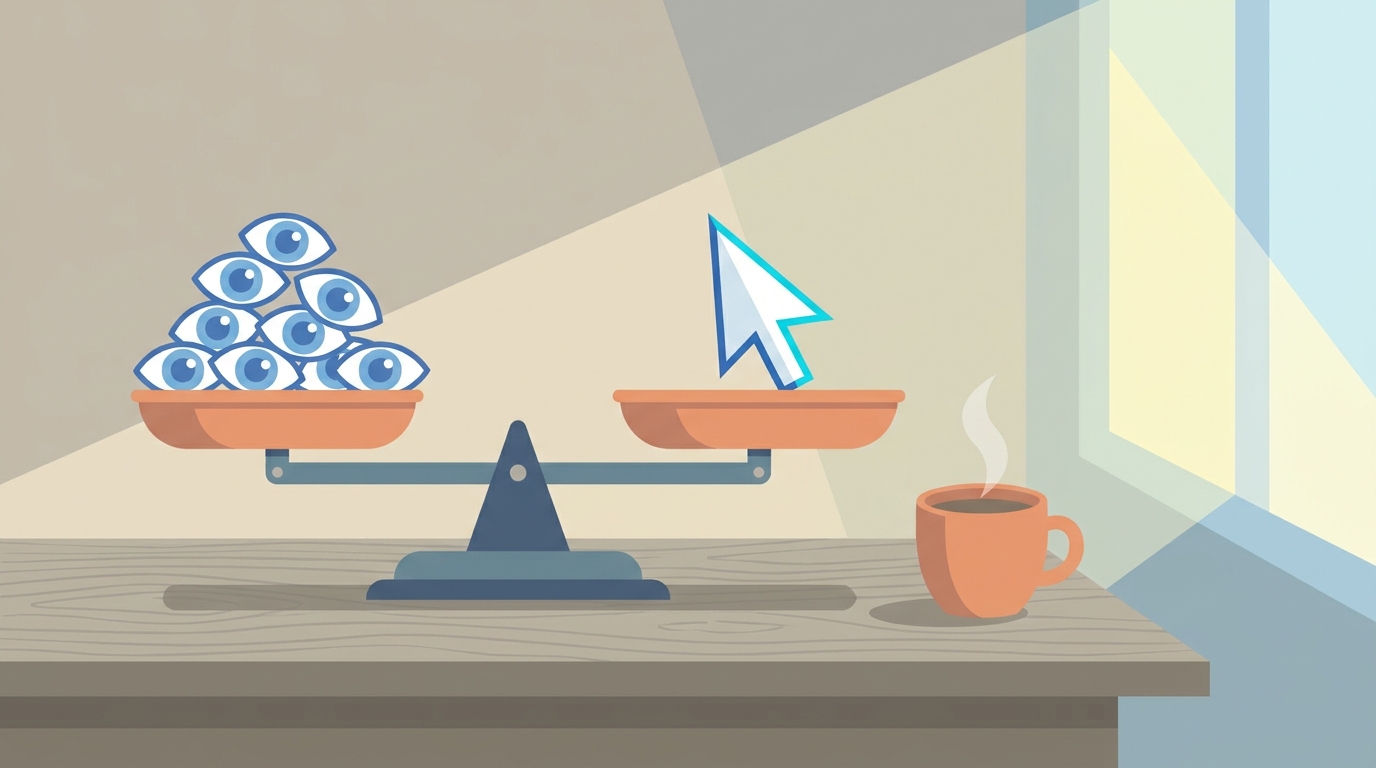
Choosing between CPM and CPC depends on your goal and your click rate. Buy on CPM when you want reach or awareness, or when your expected click rate is high enough that impressions cost less than the same clicks would. Buy on CPC when clicks are the goal and click rates are uncertain.
For CPM vs CPC, the break-even formula is effective CPM = CPC x CTR x 1,000, a calculation Digital Applied's LinkedIn benchmarks let you check against real figures.
How we compared CPM and CPC
We make Waveband DSP, a self-serve advertising platform that buys on CPM bids, so weigh our view with that in mind. We judged both models on the same five points:
- What you actually pay for (an impression or a click)
- Who carries the risk when an ad gets no response
- Cost per result at a given click rate, using the conversion math below
- Which channels usually sell each model
- Which goals each model fits
Every benchmark below names its source and the year it describes. Treat averages as starting points. Your own numbers will differ by industry, audience and creative.
What is the difference between CPM and CPC?
CPM (cost per mille) is a price per 1,000 impressions, charged whether or not anyone clicks, as the CPM figures in Digital Applied's 2026 LinkedIn benchmarks show. CPC (cost per click) charges you only when someone clicks the ad.
The formulas are simple. CPM = total cost / impressions x 1,000. CPC = total cost / clicks. If you want more on the first one, we have a full explainer on how CPM works in advertising.
Risk sits in different places. On CPM, you carry it: if 1,000 people see the ad and nobody clicks, you still pay. On CPC, the seller carries it, because the seller isn't paid for impressions that get no click. A third model, CPA (cost per action), goes further and charges only when a purchase, sign-up or other defined action happens.
How do you convert CPC to CPM?
Multiply the CPC by the click-through rate (CTR) and by 1,000. The result is the effective CPM, meaning what you are really paying per 1,000 impressions on a CPC buy. Rearranging the same formula, the CTR at which the two models cost the same is the CPM divided by (CPC x 1,000). If your CTR beats that break-even rate, buying on CPM gets you clicks more cheaply. If it falls short, CPC is cheaper.
Three worked examples, using published averages:
| Benchmark | CPC | CTR | Quoted CPM | Effective CPM from CPC | Break-even CTR |
|---|---|---|---|---|---|
| Meta, all industries, 2026 (Ryze) | $0.78 | 1.55% | $14.19 | $12.09 | about 1.82% |
| LinkedIn B2B, 2025 (Metadata) | $9.39 | 0.67% | $63.19 | $62.91 | about 0.67% |
| Facebook traffic campaigns, 2026 (WordStream by LocaliQ) | $0.60 | 1.93% | not given | $11.58 | n/a |
Here is the Meta row worked through. Ryze's 2026 Meta cost benchmarks put the all-industry CPM at $14.19, the CPC at $0.78 and the CTR at 1.55%. The calculation is $0.78 x 0.0155 x 1,000. That is below the $14.19 CPM, so an average advertiser pays less per 1,000 impressions on CPC. An ad that clicks better than that break-even rate would get cheaper clicks on CPM.
LinkedIn is close to a tie. Metadata's 2025 figures, reported by Digital Applied, give a spend-weighted CPC of $9.39, a CTR of 0.67% and a CPM of $63.19. The calculation is $9.39 x 0.0067 x 1,000 = $62.91, almost exactly the quoted CPM, which is why the break-even CTR lands at about the same 0.67% the average ad already gets.
For Facebook traffic campaigns, WordStream by LocaliQ's 2026 benchmarks, summarized by Coupler.io, show a $0.60 CPC and a 1.93% CTR. That works out to $0.60 x 0.0193 x 1,000 = $11.58 effective CPM.
To run your own numbers in the other direction, from budget to impressions, use our CPM budget calculator.
When does CPM win?
CPM wins when you're paying for attention rather than traffic. Awareness, reach and frequency goals are measured in people and impressions, so paying per impression matches what you want.
CPM also wins on cost per click when your creative and audience click well above the break-even rate. A retargeting ad shown to recent site visitors, for example, can beat the average comfortably. And on channels where nobody can click, such as a TV screen or a digital billboard, CPM is the only model that makes sense.
You will pay for impressions nobody engages with. Platform behavior also matters. A 2024 test by Two Six Technologies ran identical Facebook ads in Mali under both models. The CPM set reached about 1.1 times more people in combined reach. The CPC set delivered 2.8 times more clicks and 1.8 times more impressions for its spend. CPM bought slightly broader, less filtered reach, and it was the more expensive way to get clicks.
When does CPC win?
CPC wins when a click is the result you need and you don't yet know your click rate. Traffic and direct response campaigns fit here, along with search, where people are already looking for what you sell.
Search clicks aren't cheap. The LocaliQ and WordStream 2026 search benchmarks, summarized by Web Tonic, put the average Google Ads CPC at $5.42. By industry, the average ranges from $1.63 in Arts and Entertainment to $9.87 in Attorneys and Legal Services.
CPC has trade-offs too. A click isn't a sale, so you can pay for traffic that never converts. CPC also narrows who sees the ad. In the Two Six Technologies test, Facebook showed the CPC ads to people most likely to click. When it optimized for clicks, it even boosted impressions of the weakest ad to bring its cost per click close to the others. That is efficient for clicks but less useful for reaching new audiences.
Which model fits each channel and goal?
Use this as a guide, then check the break-even math on your own numbers.
| Channel | How it is usually sold | Goal it suits | When the other model wins |
|---|---|---|---|
| Search | CPC | High-intent traffic, leads | CPM rarely; search is built around clicks |
| Paid social | Both | Awareness (CPM) or traffic (CPC) | CPM when your CTR beats break-even (about 1.82% at 2026 Meta averages) |
| Display | CPM programmatically; CPC on some networks | Reach, retargeting | CPC when click rates are low and unproven |
| Online video | CPM | Awareness, consideration | Rarely; views matter more than clicks |
| Streaming TV (CTV) | CPM | Reach on the TV screen | Never; viewers can't click a TV ad |
| Native | CPM or CPC | Content discovery, traffic | CPC for pure traffic tests |
| Digital out of home | CPM | Local reach | Never; there is nothing to click |
Streaming TV shows why clicks are the wrong measure on some screens. Digital Applied reported in 2026 that completion rates for CTV ads top 95%. The value there is a full view on a big screen, which a CPC price can't capture.
Why programmatic channels mostly sell on CPM
Streaming TV, online video, display, native, in-app and digital out of home are bought by bidding on impressions, one auction at a time. A demand-side platform (DSP) is the software that places those bids. If you're new to it, start with what a self-serve DSP is.
In Waveband DSP, each campaign contains line items. On each line item you set a CPM bid, flight dates, lifetime and daily budgets, pacing (even or as fast as possible) and frequency caps. Before launch, an impressions estimate shows how much volume is likely available at your settings. Billing runs on a prepaid wallet: you add funds by card, each active campaign sets aside its daily budget, and you can never spend more than you funded. Campaigns pause before they overspend.
Platform fees sit on top of media cost. Our guide to how DSP take rates work explains them. If you're weighing a self-serve seat against a larger contract, see our comparison of self-serve vs enterprise DSPs.
Waveband isn't the right tool for every job. If all you want is clicks from people searching right now, a CPC search platform fits that better. Many advertisers run both: search on CPC for intent, and programmatic on CPM for reach on screens search can't touch.
CPM vs CPC: common questions
Is LinkedIn CPC or CPM?
Metadata's benchmarks report both a CPC and a CPM for LinkedIn. At the 2025 Metadata averages, a $9.39 CPC at 0.67% CTR works out to about $62.91 per 1,000 impressions, against a $63.19 CPM. At an average click rate, the two cost about the same, so pick the one that matches your goal.
Does Google use CPC or CPM?
Google uses both. CPC is common for search ads, and CPM is common for display.
What is a good CPM?
A good CPM depends on the channel. Ryze puts the 2026 Meta all-industry average at $14.19. Streaming costs more: eMarketer modeling, reported by Digital Applied, shows Netflix's average CPM falling to about $31.05 by the end of 2024. Our CPM definition and examples page covers how to read these numbers.
Can you mix CPM and CPC?
Yes, and many advertisers split them by funnel stage. Use CPM for reach on streaming TV, video and display. Use CPC to capture search intent. Then retarget the people your CPM campaigns reached.